Abstract Paint Brush Techniques: It’s always fascinating to see what lies beneath the top layer of a painting, isn’t it?
Every time I stand in front of an artwork, I find myself wondering:
What was the first mark on that surface?
How many passes did it take to arrive here?
Did the artist already know where they were heading?
Or was it completely spontaneous — built in the moment, guided only by instinct?
What was the first mark on that surface?
How many passes did it take to arrive here?
Did the artist already know where they were heading?
Or was it completely spontaneous — built in the moment, guided only by instinct?
Although I have degrees in computer-mediated art, photography and printmaking, I love the organic process of sketching. When it comes to abstract land or seascape painting, I work directly from memory. My process combines intuition with layered structure, and over time, I’ve developed my own approach to abstract paint brush techniques that allow a land or seascape to emerge gradually rather than be copied literally.
Here are my eight steps.
Step 1 – Gathering and Sketching Ideas
Everything begins with memory.
After recalling a land or seascape — in this case, the vibrant Barwon River — I sketch directly into a sketchbook. I use charcoal, soft pastels, pencils, whatever dry media I can get my hands on.
This stage isn’t about refinement. It’s about movement and exploration.
I avoid falling in love with colours or shapes too soon. When nothing feels precious, everything feels possible. This early freedom lays the foundation for stronger abstract painting techniques later in the process.
I never like to rush into things — in life or in painting.
By slowing down, I create room for discovery.
Step 2 – Playing with Opposite Colours
Next, I begin building layers with acrylic paint.
If I see green and yellow in my mind, I apply magenta or mauve tones underneath. These opposite colours create vibration and depth that subtly energise the final surface.
The underpainting is crucial.
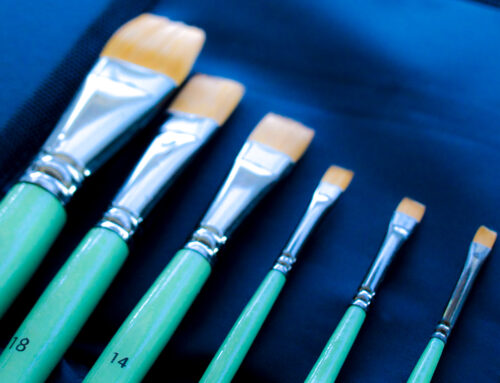
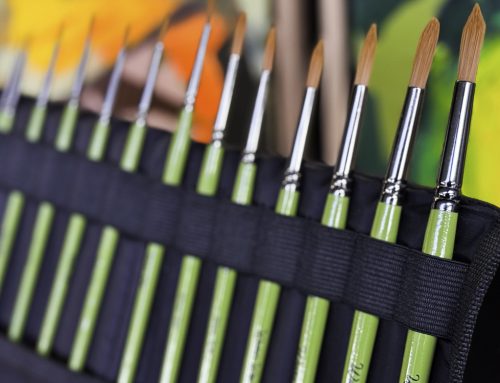
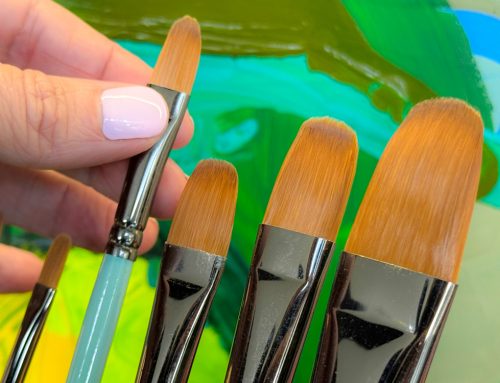
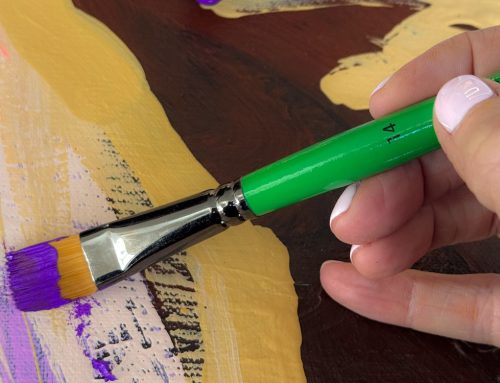
At this stage, I don’t use many different brushes, but I do love flat Hog hair paint brushes. They hold the paint well and keep their shape, which helps me create strong, textured marks. Alongside these, I also use palette knives of all shapes and sizes – anything that makes interesting, unexpected marks. These tools help my abstract paint brush techniques feel more natural and less controlled, giving the painting character from the very beginning.
Control softens. Instinct takes over.
Point Roadknight, Anglesea
When I spend time at Point Roadknight in Anglesea, I’m drawn to its wide, open horizon and shifting blues. The way the ocean stretches endlessly. The curve of the shoreline. The wind is moving across the dunes.
It’s not busy or overwhelming.
It’s expensive. Calm. Powerful.
That feeling stays with me.
But I’m not interested in painting the coastline exactly as it looks. I want to reconstruct the emotional memory of being there — the salt in the air, the vast sky, the meeting of land and sea, the rhythm of waves folding into the shore.
From that point, the painting becomes a dialogue between memory and material.
Steps 3 & 4 – Introducing the Final Colours
Now I begin introducing the colours that will remain visible in the top layer.
Composition becomes clearer. Shapes are refined. Balance begins to form.
This is where abstract paint brush techniques become more intentional. I begin choosing when to soften edges and when to define them. The painting starts breathing with more clarity.
Although described in stages, this process is never rigid. It’s intuitive and responsive — always evolving.
Steps 5 & 6 – Creating Texture
These stages are exciting.
Texture brings interest and history to the surface. I use – anything that can disrupt the paint in interesting ways.
Sometimes I scrape back entire sections.
There is always a moment of fear — the feeling that I might ruin what I’ve built.
But that risk is essential.
Layering and removing paint increase the work’s complexity and expand the possibilities of my abstract painting techniques. The surface becomes layered, rich and vibrant.
Without risk, there is no depth.
Steps 7 & 8 – Fine Tuning and Balance
The final stages are about refinement.
I bring back glimpses of earlier layers by reintroducing colour. I adjust composition, strengthen focal points, and balance hard and soft edges.
Edges matter enormously at this point. Too many hard edges make the painting rigid. Too many soft edges make it drift.
Colour is fine-tuned carefully. Small shifts create large emotional changes.
Here, my abstract paint brush techniques become precise and deliberate. Every mark has intention. Every adjustment serves harmony.
Only when the painting feels resolved — compositionally — do I stop.
A Process That Is Both Structured and Intuitive
To some, this eight-step method may sound calculated.
In reality, it feels deeply intuitive.
There is no overthinking. No fixed outcome. I never truly know how the painting will look until the final layer settles.
It is a meditative process of adding and removing — revealing and concealing — until the emotional truth of the scape emerges.
Abstract land or seascape painting, for me, is not about copying what I saw.
It’s about honouring what I felt.
And that feeling is built layer by layer through exploration, texture, risk, and the continual refinement of abstract painting techniques.
VIPurpose Abstract Paint Brush Techniques
With competitive prices and dedication towards our customer satisfaction, we here at Art Materials Australia pride ourselves on providing you with quality paint brushes. Shop paint brushes and sign up for our VIPurpose points program today and get even better discounts through our store and online purchases on all the art materials you need.
Contact us
If you have any queries, please do not hesitate to contact an Art Materials Australia creative member.
Text: 0411248217
E: orders@artmaterialsaustralia.com.au
Join us: Facebook, Instagram, TikTok, Pinterest or Youtube.