
A Beginner-Friendly Guide with Brush Techniques That Actually Make Painting Easier
A blank canvas can feel surprisingly intimidating. You sit there, brush in hand, unsure where to begin—worried you’ll “ruin” it before you’ve even started. That feeling is completely normal, especially if you’re new to acrylic painting or returning after time away.
But here’s the shift that changes everything:
There is no such thing as doing it wrong.
Abstract painting, in particular, removes the pressure of perfection. It allows you to focus on movement, texture, colour, and feeling rather than accuracy. And when you pair simple ideas with the right brushes, painting becomes not just easier – but genuinely enjoyable.
This guide isn’t just a list of ideas. It’s a practical, brush-led approach to help you create 44 easy canvas paintings using acrylics—without overwhelm.
Why Abstract Acrylic Painting Is the Best Place to Start
Acrylic paint is incredibly forgiving. It dries quickly, layers beautifully, and works across a wide range of techniques – from smooth blending to heavy texture.
Abstract painting complements this perfectly. Instead of trying to replicate reality, you’re exploring:
- Colour relationships
- Gesture
- Shape
- Texture
This means you can focus on how the paint behaves – and that’s where brushes become your most valuable tool.
Because here’s the truth most beginners aren’t told:
Your brush often determines your result more than your skill does.
Step 1: Understand Your Brushes (This Changes Everything)
Before diving into ideas, let’s simplify something that often feels overwhelming—brush selection.
You don’t need dozens. You just need to understand what each type naturally does.
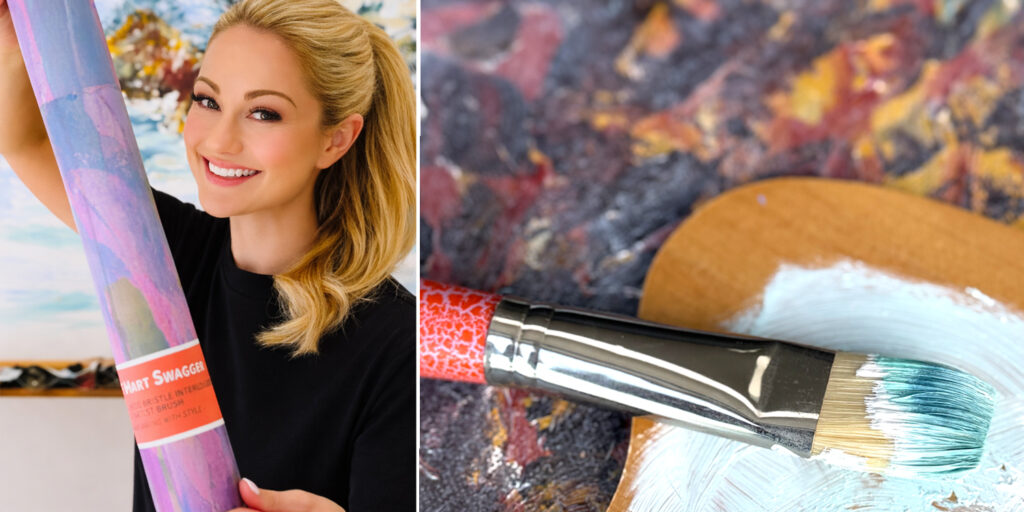
1. Hog Bristle Brushes – Texture & Expression
These are your go-to for bold, painterly work.
- Fan Brush (Hog Bristle)
Perfect for painting grass, foliage, and broken textures. The natural stiffness creates organic, uneven marks that feel effortless. - Small Hog Bristle Brushes
Ideal for expressive strokes. Try using your non-dominant hand—this removes control and creates beautifully raw, abstract lines. - Extra Large Round Hog Bristle
Great for blocking in loose shapes and creating movement across larger canvases.
👉 Best for: abstract landscapes, textured florals, expressive mark-making
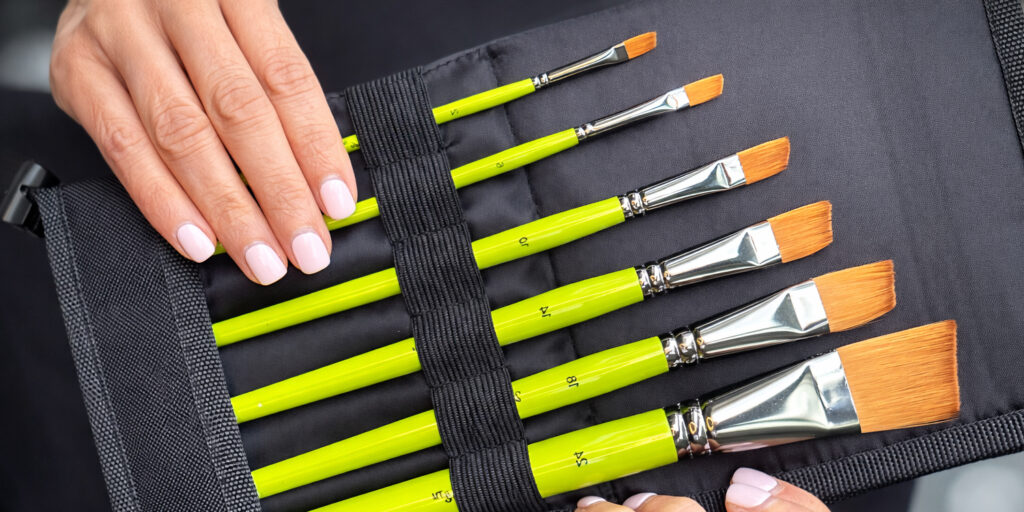
2. Nylon & Taklon Brushes – Control & Blending
Synthetic brushes are smoother and more controlled.
- Soft Nylon Fan Brush
Perfect for clouds, mist, and soft transitions in skies. - Angle Brushes (Soft Nylon)
Excellent for geometric abstraction, clean edges, and blending colour transitions.
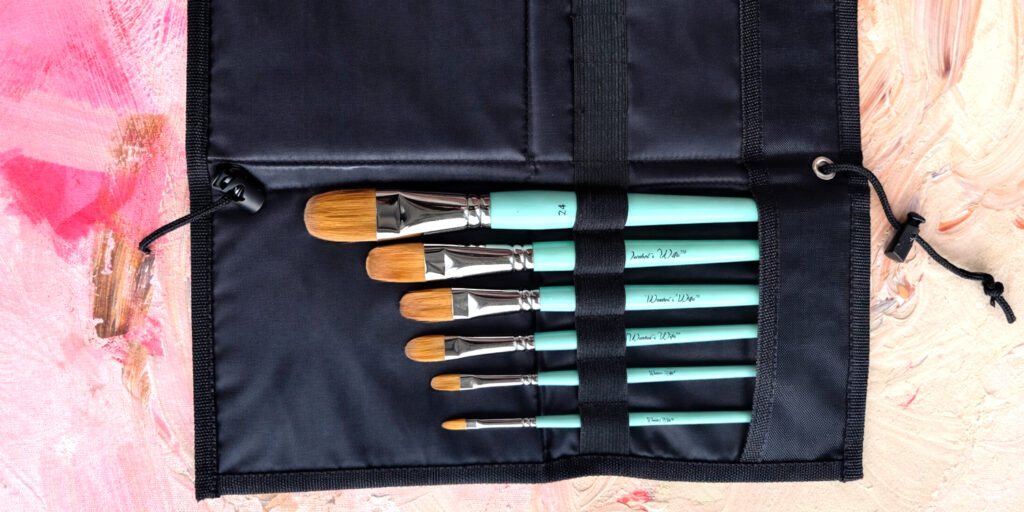
- Filbert Brushes (Nylon or Taklon)
A versatile hybrid between a flat and round brush. The soft, rounded edge is perfect for blending shapes, softe - Flat Taklon Brushes (Large)
Ideal for backgrounds, gradients, and smooth colour fields. - Long Flat Nylon Brushes
Great for long strokes—think horizons, ocean lines, or minimalist compositions. - Short Flat Nylon Brushes
Better for tighter control and layering shapes.
👉 Best for: skies, seascapes, gradients, geometric abstracts
3. Detail Brushes – Lines & Definition
These bring contrast and structure to your work.
- Rigger / Liner Brush
Designed for long, continuous lines—perfect for drips, branches, or delicate details. - Small Liner Brushes
Great for adding definition without overpowering the painting.
👉 Best for: fine lines, accents, controlled detail
4. Specialty Brushes – Character & Texture
These add uniqueness to your work.
- Stipple Brushes
Create soft, dotted textures—ideal for foliage, clouds, or abstract layering. - Round Horse Hair Brushes
Hold more paint and create fluid, expressive strokes with a softer edge.
👉 Best for: organic textures, atmospheric effects
Choosing the right brush removes frustration. Instead of forcing paint to behave, you’re working with it.
Step 2: Master Simple Abstract Techniques
Now that you understand your tools, let’s apply them.
These techniques form the foundation of most abstract acrylic paintings:
Scrape Painting
Use a palette knife to drag thick paint across the surface.
→ Combine with hog bristle textures for contrast.
→ Combine with hog bristle textures for contrast.
Pour Painting
Pour fluid acrylic and tilt the canvas.
→ Add liner brush details after drying for structure.
→ Add liner brush details after drying for structure.
Dry Brushing
Use minimal paint on a hog bristle brush to create broken, textured marks.
→ Perfect for landscapes.
→ Perfect for landscapes.
Blending & Layering
Use soft flat or angle brushes to blend colours seamlessly.
→ Ideal for skies and backgrounds.
→ Ideal for skies and backgrounds.
Stippling
Tap paint onto the canvas using a stipple brush.
→ Creates depth without detail.
→ Creates depth without detail.
Step 3: 44 Easy Canvas Painting Ideas (Grouped by Style)
Instead of overwhelming you with a random list, here are ideas grouped by subject and technique.
Abstract Landscapes (12 Ideas)
- Layered mountain ranges (palette knife + flat brush)
- Minimalist horizon lines (long flat brush)
- Autumn trees with stippled leaves
- Foggy forest using dry brushing
- Sunset gradient with silhouette trees
- Abstract fields using fan brush grass strokes
- Rolling hills in colour blocks
- Rainy landscape with vertical drips
- Desert tones with textured layers
- Metallic-highlight mountain peaks
- Loose tree lines with liner brush accents
- Expressionist countryside using bold strokes
Abstract Seascapes (10 Ideas)
- Ocean horizon with blended blues
- Textured waves using palette knife
- Minimal seascape with soft gradients
- Stormy ocean with layered greys
- Drip-effect waterfall or shoreline
- Blending textures using stipple technique
- Sunset reflection over water
- Abstract tide pools with poured paint
- Coastal cliffs using dry brush texture
- Monochrome ocean study
Abstract Florals & Nature (8 Ideas)
- Palette knife sunflowers
- Loose abstract roses
- Wildflowers with stippled centres
- Large-scale single bloom
- Organic leaf patterns
- Floral silhouettes over abstract backgrounds
- Thick-paint botanical textures
- Minimal floral line work
Pure Abstract & Techniques (10 Ideas)
- Geometric colour blocks
- Overlapping shapes with angle brush
- Drip art compositions
- Pour painting experiments
- Colour field painting
- Textured scraping layers
- Metallic abstract highlights
- Monochrome tonal studies
- Expressive brushstroke canvases
- Mixed media acrylic + watercolor effect
Creative & Graphic Styles (4 Ideas)
- Pixel painting (colour block technique)
- Silhouette over gradient background
- Abstract quote canvas
- Minimal line + colour compositions
Step 4: Let Colour Do the Heavy Lifting
In abstract painting, colour replaces detail.
Instead of asking “What should this look like?”
Ask: “What should this feel like?”
Ask: “What should this feel like?”
- Warm palettes → energy, warmth, nostalgia
- Cool palettes → calm, distance, reflection
- High contrast → drama and focus
- Soft blends → peaceful, atmospheric moods
Even a simple painting becomes powerful when the colours are intentional.
Step 5: Make It Easier (Not Harder)
If painting has ever felt frustrating, it’s rarely about talent.
It’s usually one of these:
- Using the wrong brush
- Trying to control the paint too much
- Starting with something too detailed
Simplify your process:
- Start with large brushes, not small ones
- Work from background to foreground
- Focus on movement, not perfection
- Let the brush create the effect
This is where confidence builds—not from perfect results, but from predictable tools.
Final Thoughts: Start Before You Feel Ready
Every artist—no matter how experienced—has faced a blank canvas and felt unsure.
The difference is simple: they start anyway.
Abstract painting gives you permission to explore without pressure. And when you combine that freedom with the right brushes, something shifts. Painting becomes less about “getting it right” and more about enjoying the process.
So choose a brush.
Pick a colour.
Make the first mark.
Pick a colour.
Make the first mark.
That’s all it takes.
Save this guide for your next painting session—and come back to it whenever you need inspiration, clarity, or a reminder that simple can still be beautiful.


